If there is one thing that has tested my patience more than almost anything else in life, it is people who are always late.
One of my closest friends has this habit of being late. Be it a casual coffee plan, a movie, a family get together or even going to the airport; he somehow will always be late. Almost 99% of the fights that we ever had were because of this one issue. Over the years, I have tried every possible approach. I have tried politely explaining the importance of time, many times got angry and other times made rude statements out of frustration. Sometimes I completely stopped speaking because I was afraid that if I continued talking in anger, I would say the harshest things possible. But nothing worked.
Till today, for any important event, I still have to constantly remind him, push him and follow up like a human alarm clock or else he simply won’t be ready on time and I can’t in most cases afford to take that risk.
At one point, I even tried explaining the consequences from every possible angle.
First, I told him maybe he simply doesn’t take the event seriously enough. If someone is late for an interview, airport, school or even meeting friends repeatedly, somewhere it shows that the importance of the occasion is not fully understood.
Second, I told him maybe the consequences are not painful enough yet. Some people continue being late because nothing major has happened to them so far. They still got the job or the flight somehow got delayed, friends still waited, teachers still allowed entry or the driver violated all traffic rules for him so he reaches on time. Life adjusted for them and so the brain never learns urgency.
Third, I told him maybe he is not even aware of the long-term consequences quietly building in the background. How people slowly stop trusting them, how they start appearing unreliable and careless, and how opportunities silently move towards more dependable people.
Then comes the biggest concern that carries the weight of emotion and guilt – children.
Kids don’t learn punctuality from motivational speeches but by observing daily behaviour. If children constantly see parents running late casually, they may grow up believing deadlines are flexible and commitments are optional. Slowly, this shapes their discipline, personality and future. Honestly, I now notice this behaviour everywhere around me.
My daughter has a friend who comes late to school almost four days a week and is absent on the fifth. What surprises me is not just the lateness but the complete lack of urgency around it. The school gate is about to close, yet the mother and daughter casually walk towards school laughing and strolling slowly as if nothing matters. They get the late remark and life simply moves on.
Sometimes I genuinely wonder, why are some people always late?
Over time, I realized there are many possible reasons.
Some people genuinely suffer from what psychologists call “time blindness.” They underestimate how long tasks actually take. They think getting ready needs ten minutes when realistically it needs thirty. Some are chronic procrastinators who delay everything till the last moment. Some oddly enjoy the thrill and adrenaline of rushing. Some lack discipline and structure completely while for some, unfortunately, it may simply be hidden disrespect for other people’s time.
I kind of feel there is another strange psychological reason we rarely notice, the habit of exaggerating short distances and small timings in daily conversations.
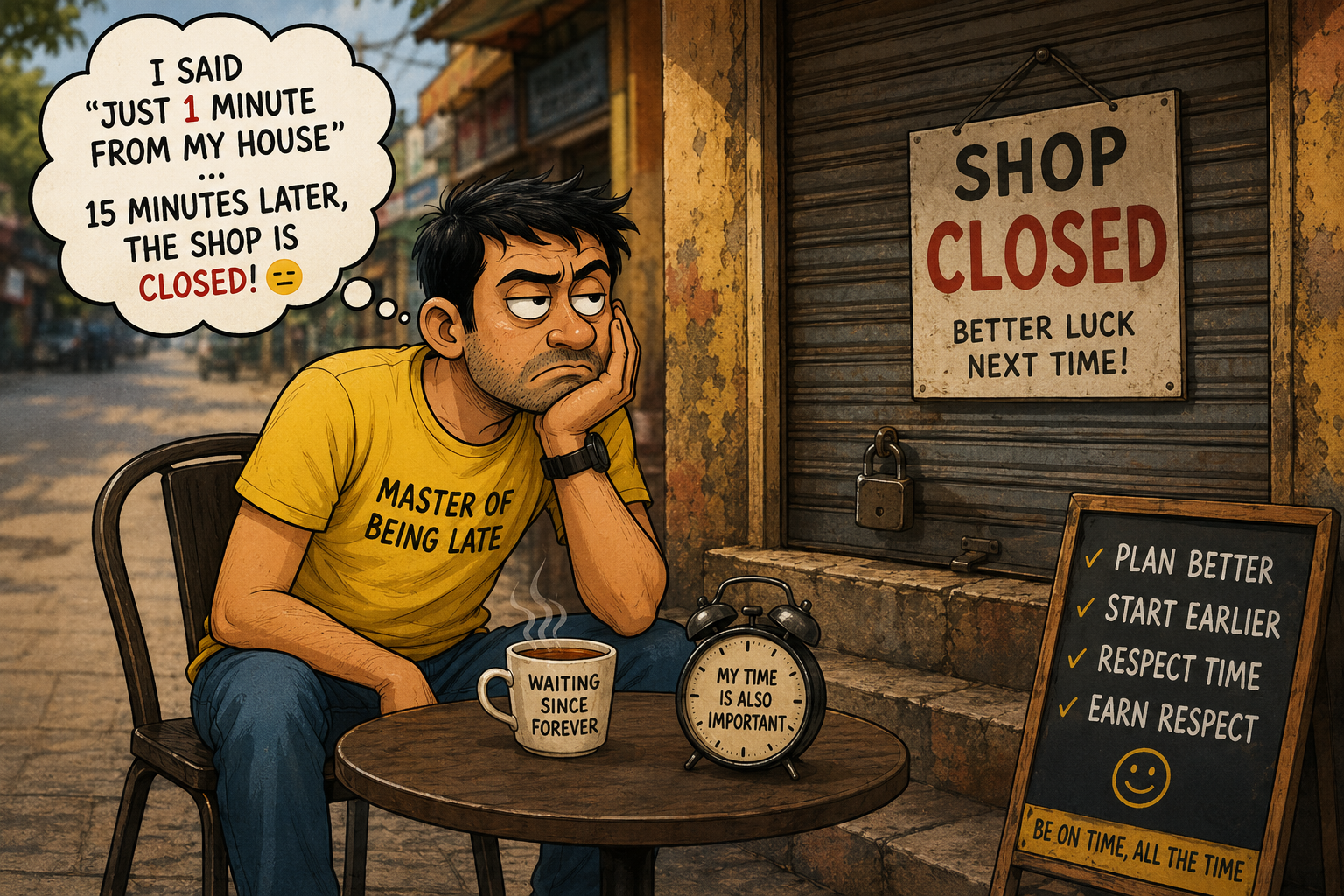
For example, a shop may be 500 metres away from home. But while speaking casually, people often say, “Oh, it’s just one minute from my house.” Slowly, after hearing and repeating such exaggerated statements again and again, the mind genuinely starts believing it.
But practically, when you actually need to go there, reality is different. You need to wear your shoes, maybe change clothes, search for keys, lock the house, wait for the elevator, walk to the shop and then buy what you need. Suddenly, that “one minute distance” actually becomes 15 or 30 minutes. Since the brain was mentally convinced it only takes one minute, people start late thinking they still have enough time. By the time they reach, the shop may already be closed.
I feel many latecomers unknowingly live with this distorted mental calculation of time. Their brain remembers the ideal timing, not the realistic timing.
One thing I have always wondered is, if a person is consistently 30 minutes late for a 9 AM appointment, doesn’t it actually mean they are capable of reaching by 9 AM if only they mentally treated it as a 9:30 AM appointment?
In simple words, maybe many latecomers are not incapable of managing time. Their internal clock is simply shifted.
If someone knows they are naturally 30 minutes late, then maybe they should start tricking their own mind. If a meeting is at 9 AM, they should mentally treat it as an 8:30 AM event. That way, even after their usual delay, they may finally end up arriving on time.
Funny solution maybe. But honestly, it makes sense to me. Sometimes self improvement is not about magically changing personality overnight. It is about understanding our own weaknesses and building systems around them.
I have actually lost many friendships over the years because of my irritation towards people being late. My reactions became extreme sometimes or perhaps I took punctuality too personally. But after waiting endlessly for people again and again, frustration naturally builds up and slowly, you start feeling that your time is not valued.
But you see, time is life.
When someone repeatedly wastes your time, it stops feeling like a small inconvenience but rather starts feeling like disrespect.
What many people fail to understand is that chronic lateness quietly damages reputation. Friends stop depending on you and employers stop trusting you. Teachers stop taking you seriously and opportunities slowly move towards people who are reliable, disciplined and respectful of time.
Being on time is not about acting like a military officer or showing off discipline. It is simply about respect. It also tells the other person, “Your time matters to me.”
In the end, clocks don’t just measure hours but also measure seriousness, reliability and respect.
—
#PunctualityMatters #RespectTime #LifeLessons #TimeManagement #SelfImprovement #Discipline #LateAgain #BetterHabits #PersonalGrowth #BeOnTime #TimeBlindness